
Practical Is Just Fear With a Better Reputation: What Swadharma Teaches Us About the Work We're Here to Do
Oct 06, 2026
Have you ever watched someone who's completely in the zone? They're performing at the highest level, fully locked in, and their work seems to flow out of them with an ease that's almost impossible to look away from.
I love tennis, so when I picture that state, I think of Novak Djokovic or Roger Federer. After watching a few of the documentaries about Taylor Swift, I think of her on tour, too. Their energy is so expansive, and their abilities are so far beyond ordinary, that I don't want to call it impossible, since they're clearly doing it, but it can seem almost superhuman.
When I slow down enough to pay attention, though, I see that same magic in everyday life, in everyday people. And I've come to believe that the difference between the people on the big screen and the rest of us isn't that they've been blessed with more talent or with a life the rest of us will never get to live. Either their gift was obvious to them from a very young age, or they did the work to discover it and then spent years cultivating it.
At the root of it, when you look at their lives as a whole and not just their performances, it becomes clear that they're living what's known in Sanskrit as their swadharma.
What swadharma means
Your swadharma (often written svadharma) is your unique personal duty in this life. It's the path that aligns with your true nature, or swabhava, and draws on the talents and gifts you were born with. It's where what you're naturally good at, what you love, and the work you were created to do all intersect. I think of it as your soul's work, the work you're here to do in this time and place, with the family and experiences that are yours.
Even though I share the cultural background this word comes from, I didn't learn it until a couple of years ago, and I fell in love with the concept right away.
Here's what I most want you to know about it: your swadharma isn't reserved for people with money, fame, or a mainstream talent that the world happens to value. Every one of us has the capacity to live it.
So why do so few of us actually do?
Why "logical" and "practical" can be fear in disguise
Part of the answer is that most of us were programmed to go with the crowd. We pick the career that makes sense, the one that puts food on the table and that other people understand and respect. It may or may not light us up inside, but it's logical, and it's practical.
I've learned to be suspicious of those two words. Logical and practical are often just fear with a better reputation. Calling a choice practical means we never have to walk up to the edge of that fear and see what's on the other side of it, and we never have to do the work of discovering what we're actually here for.
It helps to be precise about which voices are doing the talking. One of them is what I call the Inner Guard, the part of us whose entire job is keeping us safe, and who treats anything unfamiliar as a threat. The Inner Guard loves a steady paycheck and a predictable path. (I write much more about it in my book, Connected: Discovering Your Inner Guides.) The other voice is the Ego, which cares less about safety and more about how things look. The Ego wants the respected title, the career that's easy to explain, and the proof that you can do it. Between the two of them, "practical" gets a lot of airtime.
When I give my keynote on the Joy First Method™, I talk about the people who insist that you have to grind it out, that joy isn't really on the table, and that the best you can hope for is to chase happiness. The longer we listen to that voice, the longer we keep ourselves out of our joy.
Joy isn't something you earn
If you missed my earlier episode on the difference between happiness and joy, here's the short version. Happiness depends on external conditions lining up so that you can feel good, or feel in control, for a little while. Joy is different. It's an internal state that's always present, and it doesn't depend on getting the promotion, your kids picking up their rooms, or hitting every green light. You don't get joy. You uncover it.
I didn't have a plan, only a pull
This can all feel scary. I know it did for me.
For years, I was a general dentist working nine to five, five days a week, doing procedure after procedure. When people hear that, one of the first things they want to know is how I walked away from something so tangible, so stable, and so predictably safe.
The honest answer is that I didn't know what I was doing at the time. But I was following my joy. When you connect with your own sense of joy and start to live and lead from it, the rest of your life, and the people in it, begin to fall into place like the pieces of a puzzle. For me, the soul-crushing obligation to show up every day for work I'd come to hate fell away. In its place, a whole world I didn't know existed started finding me, starting with a publisher in England who reached out one day and asked if I'd write a book.
I know how it sounds when someone who walked away from her career tells you that you don't have to walk away from yours. But the leap isn't the lesson. You don't have to be rich or famous to live your swadharma, and you don't have to upend your life, quit your job, move houses, or run off to an ashram to find yourself. It starts with connecting to your joy in as many moments of your day as you can.
You don't have to hunt for your swadharma. When you live more of your life from joy, it finds you. That part is a choice, though. You have to let it.
The unlearning is the real effort
Here's the assumption I want to challenge directly: that intentional work is just hard work with better branding. That if you're doing something with focus, purpose, and joy instead of gritting your teeth through it, you're still, underneath it, working hard, just happier about it.
I don't think that's true, and I think the distinction matters more than it looks like it does from the outside.
Working with focus, dedication, passion, purpose, joy, and detachment from outcome can produce the same output as working hard. From the outside, an observer might not be able to tell the difference. But they are not the same experience, and they are not the same effort. One spends you. The other, over time, gives something back.
Being, living from what actually matters to you, aligned with your swadharma, is effortless. It's doing, the reflexive urge to grind, prove, or force an outcome, that overrides that ease and makes the work feel like hard work. So when I hear "I worked hard for this," I don't hear a character flaw. I hear someone who hasn't yet unlearned the urge to do instead of be. That unlearning, catching the reflex, and choosing purpose over proving, again and again, is the actual effort. It gets easier with practice. And it's the difference between being busy and being productive: work with purpose gets easeful, and only the work that actually matters gets done.
Federer put it his own way: "I had to work very hard to make it look easy." I take him at his word, that was true for him, in that moment, describing his own effort. But I don't think it has to be true for the rest of us just because it was true for him. Hard work is one way to get somewhere. It isn't the only way, and for most of the leaders I work with, it isn't even the way that's actually working anymore.
Triumph, disaster, and the right to your work
Something else happens when you're living your swadharma. You start to rise above the noise, and that takes real mental fitness.
Think about an artist who creates from a vulnerable place and then puts that work out into the world. One person walks by, says it's the most beautiful thing they've ever seen, and asks how much it costs. Another person looks at the same piece and wonders who would ever paint something so ugly. And plenty of people walk right past without noticing it at all.
That's the truth for all of us. We show up and do our work, and some people will appreciate it, some won't, and some might actively try to take us down. What I love about watching people like Roger Federer, Taylor Swift, or Anne Hathaway (yes, I'm an unapologetic fangirl) is that they've learned to rise above both extremes, the people who celebrate them and the people who want to see them fall. It's not that none of it touches them. They've just stopped letting it decide who they are. I've found that the more I lean into my own swadharma, the easier that's become for me, too.
Above the players' entrance to Centre Court at Wimbledon, there are two lines from Rudyard Kipling's poem "If—":
If you can meet with Triumph and Disaster And treat those two impostors just the same
Every player walks under those words on the way to some of the biggest matches of their lives, and it's a fitting reminder that winning and losing are both passing experiences. Kipling didn't say to trust triumph and distrust disaster. He said they're both impostors. Show up, do the work, enjoy it while you're out there, and leave it all on the court, without walking away with false ideas about your worth based on whether the crowd cheered or booed.
One of my favorite spiritual texts, the Bhagavad Gita, says something similar. It's essentially a guide to living without letting stress and the Ego get the better of you, and it's full of insight on tuning into yourself, cutting out the noise, and creating success that's meaningful and aligned with your swadharma. In chapter 2, verse 47, Krishna tells Arjuna that you have a right to your work, but never to its fruits. The same verse goes on to say that the fruits shouldn't be your motive, and that you shouldn't cling to inaction either. This isn't permission to stop caring or stop trying. It's an invitation to give your work everything you have, from a sense of joy, purpose, and uplifting the world, and to let go of the idea that the result gets to define you.
Small ways to let your swadharma find you
So what would it look like to let your natural gifts, and the things that light you up, show a little more?
At work, most of us live by the rule of keeping work at work and home at home. Within reason, that makes sense. But if you love baking, bring what you bake into the office. Let people see that side of you. It doesn't mean changing the way you operate. It means letting your unique humanity come through. People may see you in a new light, and you might experience your work differently, too. Just remember that you're not doing it for the result. You're doing it because you want to share what you made.
If you love to sing, sing, and it truly doesn't matter whether you're any good. If you love to dance, dance. You never know who you might inspire.
A few months ago, I was walking through JFK and noticed two airline workers with their AirPods in, clearly listening to the same song and bopping along together. When they caught me watching, they stopped. "No, no, no," I told them. "Keep dancing!" And then I stopped and danced with them. I couldn't hear the music, so I just moved to whatever was playing in my own head.
I don't even know their names. But for 30 seconds on a hectic travel day, we had a real human connection, and we laughed and moved together. It touched all three of the 3 Cs of joy at once: Creativity through movement, Community with two strangers I'll never see again, and Connection to Self in the choice to set my guard down instead of walking on by. That half a minute is still in my body. I'm smiling as I write this.
Moments like that are how it begins. Set your guard down, or at least gently set fear aside, for even 30 seconds, and live in your joy. Small choices like that ripple outward. And when you keep letting your swadharma find you, even for a few minutes a day, those minutes add up over time to courage, resilience, and a life you want to live instead of one you feel you have to.
Here's to you letting your swadharma find you, and to the inner work that makes all of the outer work worthwhile.
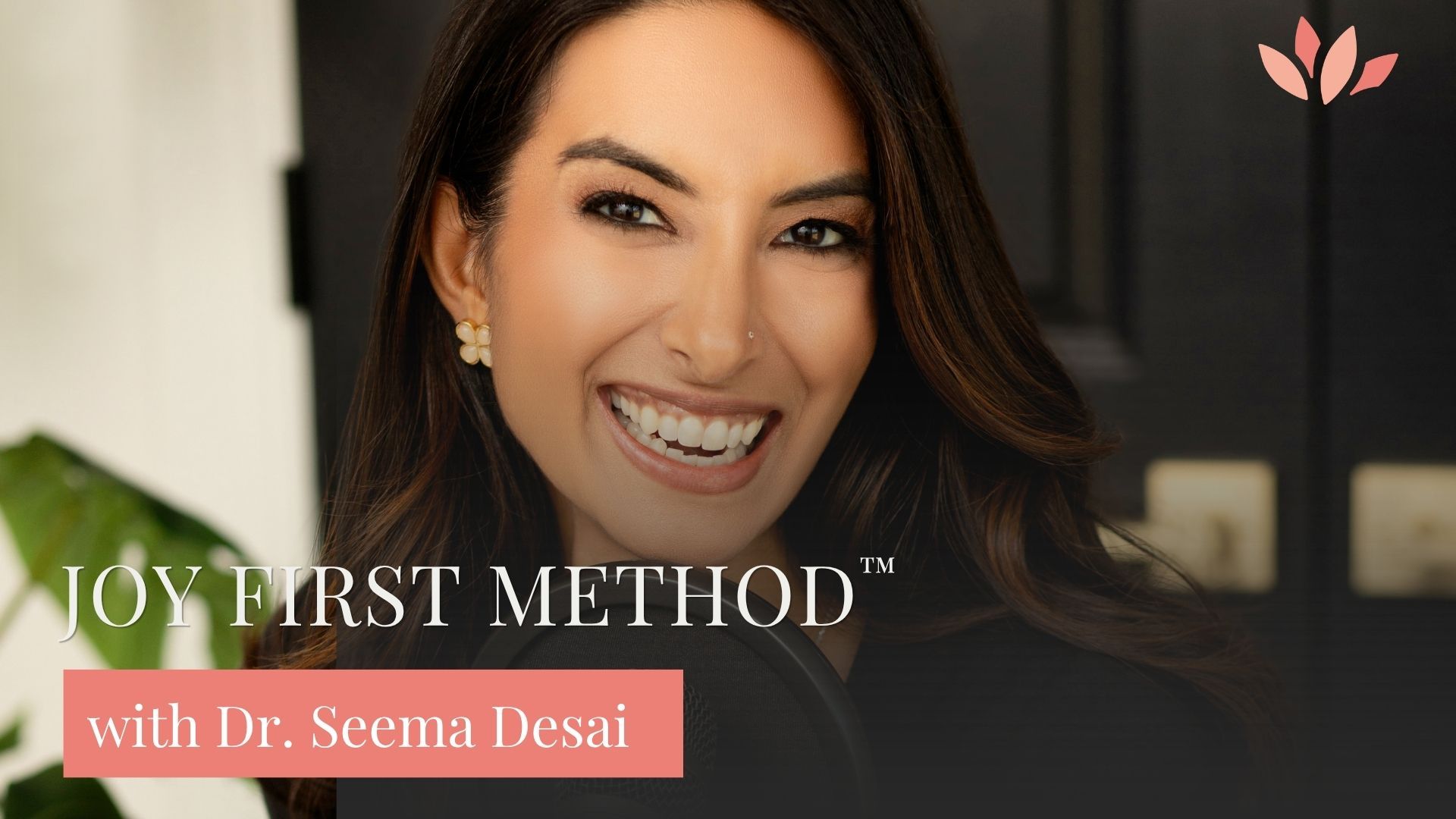
Listen to the full episode. Hear the whole conversation on the Joy First Method™ podcast: https://www.drseemadesai.com/joy-first-method-podcast
Grab the free Stress Tax Exemption™ Guide. When fear keeps making our decisions under the name of practicality, we pay for it in our energy, our health, our relationships, and our results. I call that the Stress Tax™. My free guide shares five ways high performers can move from stress to serenity: https://www.drseemadesai.com/stress-tax-exemption
Let's talk. If you're ready to explore what success that's truly yours could look like, book a clarity call. It's a conversation, not a pitch: https://calendly.com/drseema/clarity
